
TL;DR: Yes, in many cases. If you’re an heir who needs cash for your own attorney bills before probate wraps up, an inheritance advance can cover them. In return, you assign part of your expected inheritance to the provider, so you receive less later. Probate attorney fees for the executor’s lawyer usually come out of the estate itself.
Probate comes with legal bills, and most families can’t get at much cash while the estate is still open. That gap is stressful, especially in the first weeks after a loss. Between probate attorney fees, court costs, and everyday expenses, the money has to come from somewhere before the inheritance does.
This article covers who pays probate attorney fees, how and when those costs get paid, and whether an inheritance advance can help you cover them in the meantime.
Key Takeaways
- The estate usually pays the executor’s attorney. Heirs aren’t normally billed for those fees, though the fees do shrink what’s left to distribute.
- An heir who hires a separate attorney, for example to contest a will, usually pays that bill personally.
- Legal fees generally come due before heirs receive anything, which can leave a cash gap.
- An inheritance advance can fund legal costs during probate. The price is a smaller inheritance later, so compare the dollar amounts before you sign.
Disclaimer: This article provides general information and does not constitute legal, tax, or financial advice. Probate procedures and attorney compensation requirements vary by state.
What Are Probate Legal Fees?
Legal fees for probate cover the work of settling an estate: attorney compensation, court filing fees, required notices, and administrative items such as appraisals and accounting. What you pay depends on how complicated the estate is, how the attorney bills, and your state’s rules. A simple estate may need very little legal help. A contested will or a stack of creditor claims can run the total up fast.
Probate lawyer fees are billed hourly, as a flat fee, or by a statutory schedule. California uses the last approach. California Probate Code 10810 sets the attorney’s fee for ordinary services at 4% of the first $100,000 of the estate, 3% of the next $100,000, 2% of the next $800,000, and smaller percentages above that. Section 10811 allows extra fees for extraordinary services, with the court’s approval.
Who Pays Probate Attorney Fees?
Who pays probate attorney fees depends on who hired the attorney. When the executor hires one to run the estate, the fees are paid from estate assets and the executor handles payment. Heirs aren’t normally billed personally, although the fees do reduce what’s left for them.
Attorney Fees Paid by the Estate
The executor’s attorney prepares court documents, deals with creditor claims, and helps with distributions, so the cost counts as an estate expense. Payment may need court approval, depending on the state.
Take a California estate worth $250,000. The statutory fee for ordinary services comes to $8,000, which is 4% of the first $100,000, plus 3% of the next $100,000, plus 2% of the remaining $50,000. That fee is paid from the estate before anything is distributed, so each heir’s share ends up a little smaller.
Attorney Fees Paid by Individual Heirs
If you hire your own attorney, say to contest a will or protect your share, you’re usually the one paying that bill. Reimbursement from the estate is possible in some cases but never automatic, so don’t count on it.
When you’re working out who pays attorney fees in probate, ask whose lawyer it is. The executor’s attorney represents the executor, not individual heirs. Yours represents you.
When Are Legal Fees Paid During Probate?
Fees are usually paid before assets go out to heirs. Some attorneys ask for a retainer up front, others bill as the case moves along, and some wait for court authorization. Either way, the estate has to cover its bills and debts before the inheritance is distributed.
That creates a gap, because the expenses show up now and the money isn’t available yet. The California Courts probate guidance describes the order of events: the personal representative collects the property, pays the bills, and then distributes what’s left. Being named in a will doesn’t give you access to estate funds. That’s the general rule everywhere, though procedures vary by state.
The gap hurts most when you’ve hired your own lawyer or have other bills due while you wait.
What If There Isn’t Enough Cash Available to Cover Legal Fees?
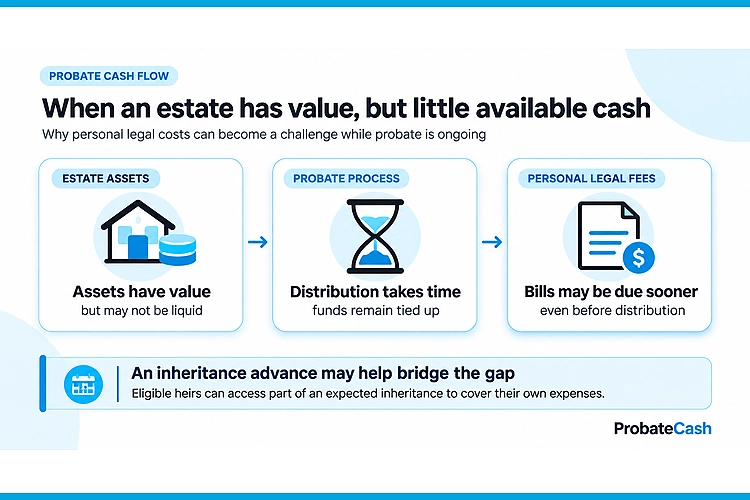
An estate can be worth a lot on paper and still be short on cash. Say a house makes up most of the value while the bank accounts hold very little. Selling the house or collecting other assets takes time, and the bills don’t wait. That can delay payments and put real pressure on the executor.
The executor may need to collect outstanding funds, arrange an authorized sale of property, or work out payment terms with providers, all within probate rules and the executor’s duties.
Heirs have their own version of this problem. If you’re paying a personal attorney while your inheritance sits in probate, an inheritance advance may get you to the money sooner.
Can You Use an Inheritance Advance to Pay Legal Fees?
Yes, in many cases. An inheritance advance gives you part of your expected inheritance up front, before probate is complete, in exchange for assigning a portion of your eventual distribution to the provider. You can generally use the money for personal attorney bills or other expenses, subject to the agreement’s terms.
Unlike a loan, a non-recourse advance has no monthly payments, and in most cases you don’t owe the difference out of pocket if the estate comes up short. The provider is paid from your share when the estate distributes assets. Read the agreement for any exceptions and for requirements in your state.
An advance on inheritance makes the most sense when you’ve personally taken on legal costs the estate isn’t responsible for. Taking one doesn’t shift the estate’s legal obligations onto you. Before you accept an offer, compare the cash you receive with the inheritance you’re assigning. We explain the differences between an advance versus loan if you’re weighing both.
How an Inheritance Advance Works for Legal Costs
The process is short. You share a few details about the estate and your expected inheritance, the provider reviews them, and you get a written offer if funding is available. Approval depends on the estate’s circumstances and your paperwork. In four steps:
- Apply for an advance: Share information about the estate and your expected inheritance.
- Review the offer: Check the cash you’d receive, the amount you’d assign, and the agreement terms.
- Receive the funds: Once approved, use the money for legal bills or other expenses.
- Repay from the estate: When probate distributes assets, the provider receives its agreed portion straight from your share.
ProbateCash offers non-recourse inheritance advances with no loan interest and no monthly payments. Review the full agreement before you sign, including the assigned amount and any exceptions. You can read more about the inheritance advance process and the cost of an advance before you apply.
Cover Legal Fees Without Waiting for Probate to Close
Probate costs are normal, but they’re hard to manage when your money is tied up. The estate’s attorney is usually paid from the estate, and you may still face your own legal bills while you wait. An advance can bridge that gap. It also reduces what you receive later, so review the full terms and decide whether the cash now is worth the cost.
Got legal bills due and an inheritance still tied up in probate? Request a quote from ProbateCash and you’ll get a written offer showing exactly how much cash you’d receive and how much of your inheritance you’d assign. Funding often arrives within 24 hours of final approval, there are no monthly payments, and you decide whether the numbers work before you sign anything.
Stop Waiting for Probate
Access your inheritance in as little as 24 hours with a risk-free, non-recourse advance. No credit checks, no monthly payments.
FAQs
Are Probate Attorney Fees Paid Upfront?
Sometimes. Some attorneys ask for a retainer, others bill as the case goes along or get paid after the court approves their fees. Fees for the executor’s attorney generally come from estate assets, not from heirs’ pockets.
Can Heirs Pay Legal Fees Before Probate Ends?
Yes. You can pay your own attorney with personal funds, or chip in toward estate costs voluntarily. Paying estate expenses yourself doesn’t guarantee reimbursement, so settle that with the executor first.
Are Legal Fees Deducted From Inheritance?
Estate administration fees are paid from the estate before distribution, so they lower the total available to heirs. A personal attorney’s bill for one heir isn’t automatically charged to the whole estate, though a court order or state law can change that.
Can an Inheritance Advance Be Used for Other Expenses?
Usually. ProbateCash’s site says you may use the funds as needed, so housing, medical bills, and debt payments are all possible, depending on your agreement. Because you’re assigning part of your inheritance, review the full terms first.
Disclaimer: This article provides general information and does not constitute legal, tax, or financial advice. Probate procedures and attorney compensation requirements vary by state.