Losing someone you love is hard enough. Waiting a year or more to receive your inheritance while bills pile up makes it harder. If the estate you’re inheriting qualifies as a “small estate” under California law, you may be able to collect assets in weeks — without ever stepping inside a probate courtroom. That tool is called the California small estate affidavit, and for the right estate, it changes everything.
What Is a California Small Estate Affidavit?
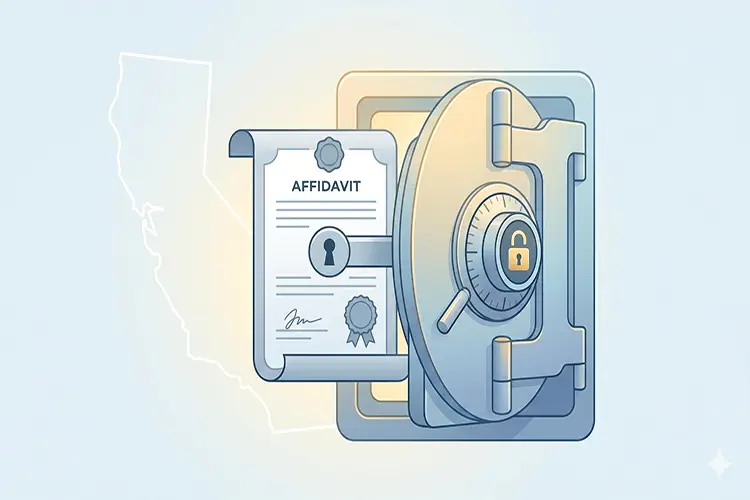
A California small estate affidavit is a sworn legal document that allows an heir or beneficiary to claim a decedent’s assets directly — no formal probate required. It is authorized under California Probate Code § 13100, which gives asset holders (banks, brokerages, the DMV) a legal obligation to release property to the person presenting a valid affidavit. This is not a court petition. It is an out-of-court alternative designed to move faster and cost far less than the formal probate process.
Think of it as a shortcut built into the law for smaller estates. Instead of waiting for a judge to authorize each distribution, you present the affidavit directly to whoever is holding the asset. They verify it, and they release the property to you.

Who Qualifies? The $208,850 Threshold Explained
The procedure is only available when the gross value of the decedent’s California property subject to probate does not exceed:
- $166,250 if death occurred before April 1, 2022,
- $184,500 (death on or after April 1, 2022)
- or $208,850 (death on or after April 1, 2025).
This figure is adjusted every three years under California law — the current threshold reflects the 2025 adjustment, so verify the number is still current before you act. Gross value means the fair market value of the assets, not what remains after debts are paid.
If you’re unsure whether the estate clears that line, you’ll need to identify which assets count toward the limit and which ones are excluded. The distinction matters a great deal.
Assets That Count Toward the Limit
- Bank and savings accounts held solely in the decedent’s name
- Vehicles and personal property titled solely to the decedent
- Brokerage or investment accounts without a named beneficiary designation
- Business interests owned solely by the decedent
- Uncashed checks, refunds, or wages owed to the decedent
Assets Excluded From the Calculation
- Property held in joint tenancy with right of survivorship
- Life insurance policies with a named beneficiary
- Retirement accounts (401(k), IRA) with a named beneficiary
- Assets held in a living trust
- Community property passing directly to a surviving spouse
- Payable-on-death (POD) and transfer-on-death (TOD) accounts
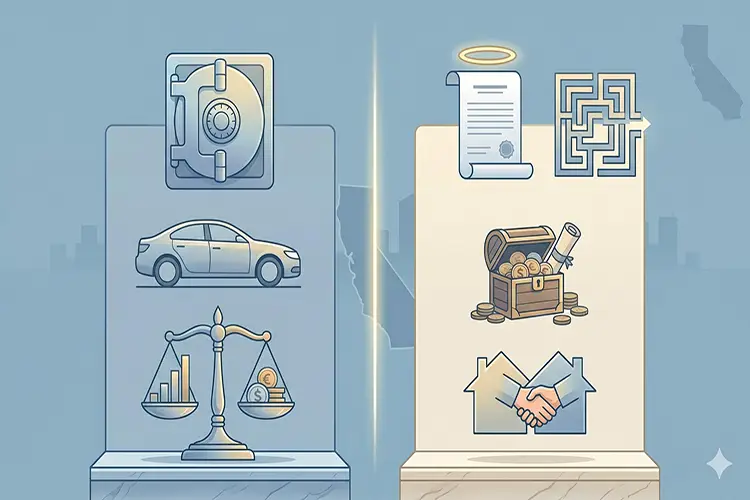
Only the assets that would otherwise go through probate count toward the $208,850 cap. A large life insurance payout to a named beneficiary does not push an estate over the threshold — it passes entirely outside of probate.
Step-by-Step: How to Use the Affidavit Procedure (Probate Code § 13100)
The process is straightforward, but each step must be followed precisely. One misstep — like acting too early — can invalidate the entire affidavit. Here’s what the procedure actually looks like.
Step 1 — Wait 40 Days After the Death
California law requires a mandatory 40-day waiting period from the date of death before you can present a small estate affidavit. There are no exceptions and no workarounds. The 40-day rule exists to give creditors and other potential claimants time to surface before assets are distributed. Mark the date on your calendar and do not approach any asset holder before that window closes.
Step 2 — Gather Required Documentation
The core documents required for every affidavit include:
- Form DE-300 — the Maximum Values for Small Estate Set-Aside and Disposition of Estate Without Administration, which establishes the current threshold values
- A certified copy of the death certificate — not a photocopy, but the official version with a raised or official seal from the county recorder; request several, as each asset holder will want their own
- Evidence that the decedent owned the property you are claiming — examples include a stock certificate, bank passbook, or storage receipt
- Reasonable proof of identity for each person signing the affidavit — a driver’s license or passport satisfies this requirement
- An Inventory and Appraisal of all real property owned by the decedent in California, if any, performed by a court-approved probate referee as required under Probate Code § 13103; the court can provide a list of approved referees
- Proof of your status as a rightful heir — either a copy of the will naming you, or documentation of your relationship to the decedent if the estate passes by intestate succession
If you are transferring stocks or bonds, three additional documents are required. Each must be signed by the person or persons entitled to the securities:
- An Affidavit of Domicile
- A Transmittal Letter
- A Stock or Bond Power
Missing any one of these items gives the asset holder grounds to reject your affidavit on the spot. Assemble the complete package before you submit anything.
Important Reminder
A certified death certificate is not the same as a photocopy — you need the version with a raised or official seal from the county recorder. Request several certified copies, because different asset holders will each want their own.
Step 3 — Complete and Present the Affidavit
The affidavit itself must be signed under penalty of perjury and, in most cases, notarized. It must state that the estate’s gross value does not exceed the threshold, that 40 days have passed since the death, and that no probate proceeding is pending or has been filed.
Once a valid affidavit is presented, the bank, brokerage, or other holder is legally required to release the asset to you within a reasonable timeframe — no court order needed. No filing fee. No judge. No waiting for a court date.
Real Property: Spousal & Domestic Partner Simplified Procedure
The § 13100 affidavit does not apply to real property — land, houses, or other real estate. For real property, California law provides a separate simplified procedure under Probate Code § 13150, which allows a surviving spouse or registered domestic partner to petition the court to confirm that property passes to them without full probate. This is a different process, with different forms and a court filing requirement, but it is still far faster than standard probate. If real property is involved, consult a California probate attorney to determine which procedure fits your situation.
Common Mistakes That Invalidate Your Affidavit
The affidavit procedure is designed to be accessible, but it is still a legal document. These are the errors that most commonly derail the process.
You have legal options. Courts can compel executors to act, remove them if necessary, and hold them accountable for losses caused by their inaction. State deadlines apply, so acting sooner rather than later matters.
- Underestimating the gross estate value. If assets you overlooked push the estate past $208,850, the affidavit is invalid, and formal probate is required.
- Presenting the affidavit before 40 days have passed. The asset holder has both the right and the obligation to refuse a premature affidavit.
- Using § 13100 for real property. Real estate requires the § 13150 procedure — the wrong form sent to the wrong party accomplishes nothing.
- Missing notarization or required signatures. An unsigned or unnotarized affidavit is not a valid legal document, and the holder will reject it.
- Failing to include all required declarations. The affidavit must confirm the waiting period, the estate value, and the absence of a pending probate proceeding — leaving out any of these elements creates grounds for refusal.
If an asset holder disputes your affidavit, you may need to resolve the matter through a court proceeding, which defeats the purpose. Getting it right the first time saves you weeks.
Stop Waiting for Probate
Access your inheritance in as little as 24 hours with a risk-free, non-recourse advance. No credit checks, no monthly payments.
What If the Estate Exceeds $208,850? Your Options
When an estate’s gross value crosses the threshold, the small estate affidavit is no longer an option. Formal probate in California is required, and that process typically takes 12 to 24 months — sometimes longer in high-volume counties like Los Angeles. Court fees, attorney fees, and executor commissions add up quickly, and you receive nothing until the court authorizes a distribution.
For a deeper look at how long the formal process actually takes and what drives delays, see our guide on Probate Duration: Los Angeles County vs. San Francisco. If you’re also sorting out who the legal heirs are before filing, our article on California Intestate Succession Laws walks through the rules in detail.
The wait is real. But you don’t have to go the entire stretch without access to funds.
How ProbateCash Can Help When You’re Waiting

If the estate doesn’t qualify for the affidavit procedure and you’re facing a lengthy probate, Probate Cash can step in. We purchase a portion of your expected inheritance today — giving you cash now while the court process runs its course. This is not a loan. There are no monthly payments, no interest charges, and no credit check required. If the estate doesn’t pay out for any reason, you owe us nothing — the risk stays entirely with Probate Cash.
We work with Probate Estates, Trust Estates, and some International Estates. Funding can happen in as little as 24 to 48 hours after documentation is received. You shouldn’t have to wait for what is rightfully yours.
Frequently Asked Questions
How long does a small estate affidavit take in California?
After the mandatory 40-day waiting period from the date of death, the process itself can move quickly. Once you present a complete and valid affidavit to the asset holder, they are required to release the property within a reasonable time — in practice, many banks and brokerages process it within a few business days to a few weeks. The total timeline from death to receiving the asset is typically 6 to 10 weeks for straightforward cases.
Can I use a small estate affidavit for a house in California?
No. The § 13100 affidavit procedure applies to personal property, not real estate. If you are not a surviving spouse or domestic partner, real property will likely require formal probate regardless of the estate’s total value.
Do I need a lawyer to file a small estate affidavit in California?
California law does not require you to hire an attorney to use the § 13100 affidavit procedure. However, if the estate is at or near the $208,850 threshold, if there are multiple heirs, or if any heir’s status is disputed, consulting a licensed California probate attorney is strongly recommended. A lawyer can also help if an asset holder refuses to comply with a valid affidavit.
What happens if the estate value is disputed after I submit the affidavit?
If a creditor, another heir, or the asset holder challenges the affidavit — for example, by arguing the estate value actually exceeds the threshold — the matter may need to be resolved through a court proceeding. Under California Probate Code § 13105, a person who wrongfully takes property using an affidavit is liable for damages, so accuracy in your sworn statements is essential. When disputes arise, the simplified procedure loses its speed advantage, and legal guidance becomes necessary.
Is the $208,850 limit based on all assets or just probate assets?
Conclusion
The California small estate affidavit is one of the most useful tools in probate law for heirs dealing with smaller estates. It cuts months — sometimes well over a year — from the time it takes to receive assets. If the estate qualifies under the $208,850 threshold, there is no court filing, no hearing, and no judge standing between you and your inheritance. Follow the steps carefully, wait the full 40 days, and present a complete, notarized affidavit to each asset holder.
If the estate doesn’t qualify, or if you’re already in the middle of a formal probate and need funds now, Probate Cash is here. We offer non-recourse inheritance advances with no credit check, no monthly payments, and funding in as little as 24 to 48 hours.
This article is for informational purposes only and does not constitute legal advice. Consult a licensed California probate attorney for your specific situation.
Resources:
1. “Affidavit for Collection of Personal Property (Small Estate Affidavit) Step by Step Guide.” Sacramento County Public Law Library, 12 May 2026, saclaw.org/resource_library/affidavit-for-collection-of-personal-property-2/. Accessed 15 May 2026.
2. Chen, Andy. “Enforcing a California Small Estate Affidavit (ca Probate Code Section 13105) | the Law Offices of Andy I. Chen.” Andychenlaw.com, 2019, andychenlaw.com/enforcing-a-california-small-estate-affidavit-ca-probate-code-section-13105/. Accessed 19 May 2026.